Article
Mar 20, 2026
How to Fix Feature-Led Messaging in B2B SaaS: A PMM Playbook
Most B2B SaaS companies describe their product the way engineers built it, not the way buyers need to hear it, and this playbook shows you exactly how to audit, tear down, and rebuild your messaging around outcomes.
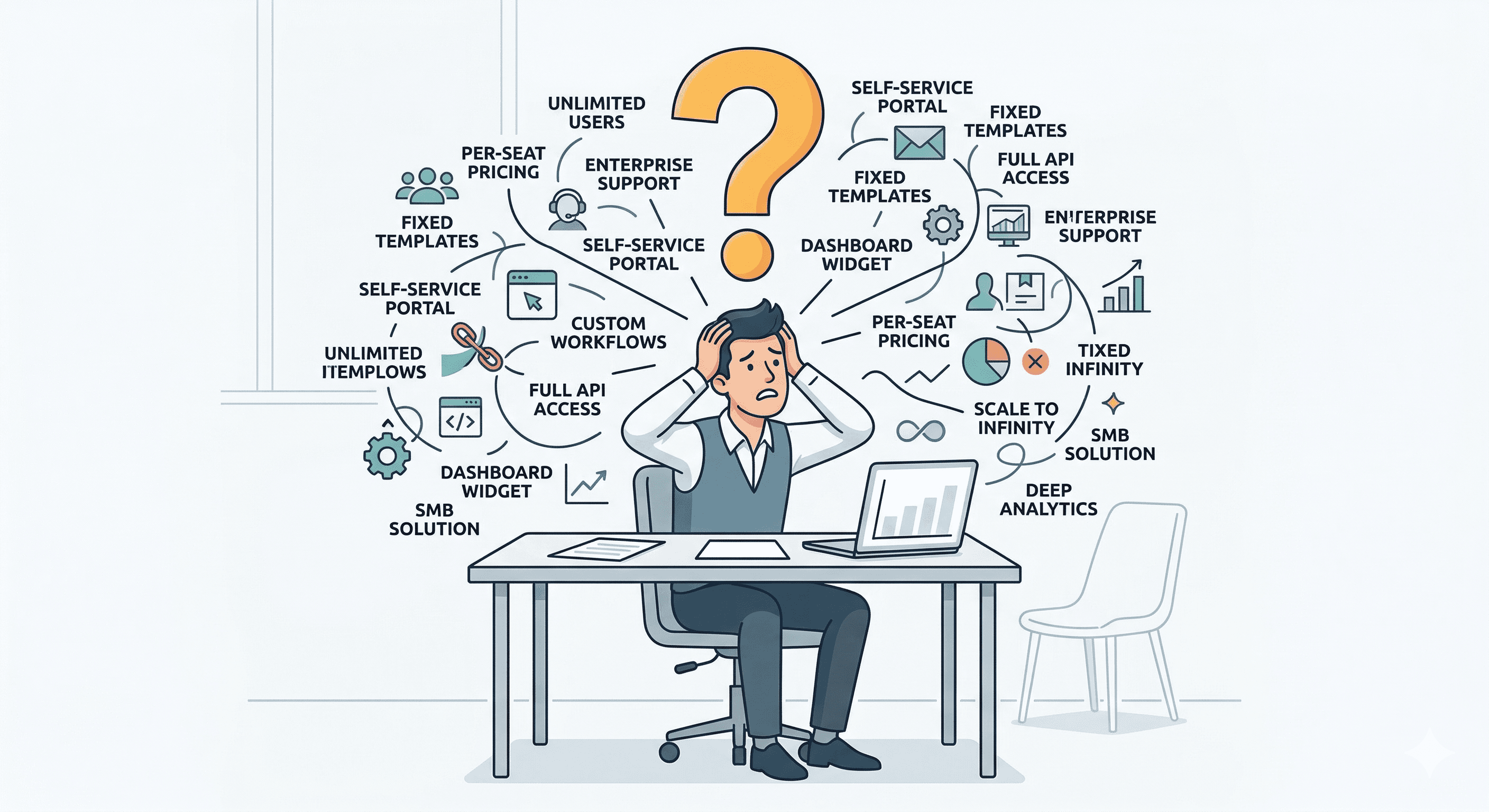
Your product's biggest competitor isn't the other startup with the better logo. It's your own homepage.
Specifically, the part of your homepage that reads like a spec sheet written by someone who just merged a pull request. "Robust API integration capabilities." "AI-powered workflow automation platform." "Seamless cross-functional collaboration tools for modern enterprises."
Nobody has ever read any of those sentences and thought, "Finally. The solution to the thing keeping me up at night."
And yet, this is how most B2B SaaS companies talk about themselves. Feature-first, buyer-last. The product team ships something they're proud of. Marketing describes it the way engineering explained it in the internal Slack channel. Sales copies the homepage into the first slide of the pitch deck. And then everyone wonders why prospects nod politely during demos and vanish after the follow-up email.
The problem isn't the product. The problem is that the messaging is built around what the product does instead of what changes for the buyer when they use it.
This playbook walks through how to diagnose, dismantle, and rebuild feature-led messaging into something that actually generates pipeline.
Step 1: Run the "So What?" Audit
Before you rewrite anything, you need to know exactly where the messaging breaks down. Here's the fastest way to find out.
Pull up your homepage, your sales deck, and your top-performing outbound email. Highlight every claim that describes a feature or capability. Now read each one out loud and ask: "So what? What changes for the buyer?"
If the answer is buried two logical leaps away, the messaging is feature-led.
Example:
"Our platform offers real-time data synchronization across all connected tools."
So what?
"So your team always has the latest numbers."
So what?
"So your ops manager stops wasting 3 hours a week reconciling reports from two different dashboards before the Monday leadership meeting."
That third version is the message. The first one is a feature. The second one is a benefit that's still too vague to make anyone care. The third one is specific enough that a real human with a real calendar and a real Monday meeting can see themselves in it.
Run this exercise on every major claim across your homepage, sales deck, and outbound sequences. You'll probably find that 70% or more of your messaging never gets past the first "so what."
Step 2: Identify the "Feature Graveyard" Pattern
There's a specific failure mode that shows up in almost every B2B SaaS company that doesn't have a dedicated PMM function. I call it the Feature Graveyard.
It works like this. Every time the product team ships something new, marketing adds it to the list. The homepage becomes a growing catalog of capabilities. The sales deck gets another slide. The one-pager gets another bullet point.
After 12 months, you have a homepage with 27 bullet points, a sales deck with 34 slides, and a one-pager that requires a magnifying glass. Every feature is technically accurate. None of them are memorable. And the buyer walks away remembering nothing because when everything is highlighted, nothing stands out.
The Feature Graveyard kills messaging because it treats every feature as equally important to the buyer. They're not. Three of those 27 bullets are probably doing 80% of the heavy lifting in closed-won deals. The rest is noise that dilutes the message.
The fix: go back to your win/loss data, your customer interviews, or (if you have neither) your sales team's gut instinct. Ask one question: "When a deal closes, what are the top three reasons the buyer chose us?"
If those three reasons aren't the first things a prospect sees and hears across every touchpoint, your messaging has a prioritization problem.
Step 3: Rebuild Around the Buyer's "Before and After"
Feature-led messaging describes the product. Buyer-led messaging describes the buyer's life before and after the product.
This is the single most important reframe in B2B SaaS positioning, and it's the one most companies skip because it requires actually knowing your buyer's daily reality.
Here's how to structure the rebuild:
The "Before" state: What is the buyer's world like right now, without your product? Be painfully specific. Not "inefficient processes." More like: "Your RevOps lead spends every Friday afternoon manually exporting data from three tools into a spreadsheet so the VP of Sales has a pipeline report for the Monday standup. It takes 4 hours. It's wrong 30% of the time. And nobody trusts the numbers anyway."
The "After" state: What does their world look like once your product is in place? Same level of specificity. "The pipeline report builds itself. It's accurate. The VP of Sales opens it Monday morning and the meeting is about strategy, not data cleanup. Your RevOps lead gets Fridays back."
The bridge: Your product is what gets them from before to after. But the product details come third, not first. Lead with the pain. Follow with the outcome. Then explain how.
This structure works because it mirrors how buyers actually make decisions. Nobody wakes up and thinks, "I need AI-powered workflow automation." They think, "I'm sick of spending 4 hours on this report every Friday." The messaging that matches how they think about the problem is the messaging that earns the click and the call.
Step 4: Kill the Jargon (Even the Stuff You Think Is Fine)
There's a specific type of jargon that B2B SaaS companies are addicted to, and it's not the obviously bad kind. Everybody knows "synergize" and "best-in-class" are terrible. The harder jargon to spot is the kind that sounds professional but communicates nothing.
Words like:
"Streamline" (doing what, for whom, and compared to what?)
"Optimize" (the vaguest promise in enterprise software)
"Platform" (used by companies with 2 features and a settings page)
"Solution" (a word that only exists in marketing copy, never in a buyer's vocabulary)
"Empower" (nobody has ever felt empowered by a SaaS dashboard)
"Seamless" (nothing in enterprise software is seamless and everybody knows it)
The test: can you swap in a competitor's name and have the sentence still be true? If yes, the messaging isn't differentiated. It's wallpaper.
Replace jargon with specifics. "We streamline your workflow" becomes "We cut the time it takes to onboard a new customer from 14 days to 3." The second version is harder to write because it requires knowing the actual impact. That's exactly why it works.
Step 5: Pressure Test With Three Audiences
You've rewritten the messaging. Before you ship it everywhere, run it through three filters.
Filter 1: The Sales Rep Test Show the new messaging to your top-performing AE. Ask them: "Would you use this language on a call tomorrow?" If the answer is "it's good but I'd say it differently," the messaging is still too polished and not enough like how real conversations happen. The best messaging sounds the way your best rep already talks when they're on a hot call.
Filter 2: The Buyer's Mom Test Could someone outside your industry read your homepage and explain what you do in one sentence? Not the technical details, just the basic "what problem do they solve and for whom?" If the answer is no, you've replaced one type of jargon with another. Clarity beats cleverness.
Filter 3: The Competitor Swap Test Take your headline, your tagline, and your top three value props. Replace your company name with each competitor's name. If the messaging still works with their name on it, you haven't said anything distinctive. Go back and sharpen until the messaging could only be about you.
Step 6: Roll It Out Without a 3-Month Committee Process
This is where most messaging projects die. The rewrite is done, it's good, and then it enters the "alignment" phase where seven stakeholders give contradictory feedback over six weeks until the final version is a watered-down consensus that excites nobody.
Here's a faster path.
Get the CEO and the Head of Sales (or whoever owns the number) in a room for 60 minutes. Present the new messaging. Get a yes or a "change this one thing." Two people. One meeting. Done.
Then roll it out in layers, not all at once:
Week 1: Update the homepage headline, subhead, and CTA. This is the highest-traffic touchpoint and the fastest signal.
Week 2: Rewrite the sales deck's first five slides. The opening of the pitch is where messaging matters most. The feature slides can wait.
Week 3: Update the top-performing outbound sequence. One sequence. Not all of them. Test the new messaging against the old and measure reply rates.
Week 4: Brief the full sales team. Not a 90-minute training. A 15-minute Loom that says: "Here's what changed, here's why, here's the new talk track."
Everything else (one-pagers, battlecards, website feature pages, help docs) gets updated over the next quarter as part of the normal workflow. Not as a separate project with its own Gantt chart.
The Bottom Line
Feature-led messaging is the default in B2B SaaS because it's the path of least resistance. The product team ships a feature, marketing describes the feature, sales pitches the feature. It's logical. It's also wrong.
Buyers don't care about your features. They care about their problems. The companies that win are the ones that describe the buyer's world more accurately than the buyer can describe it themselves, and then show how that world changes.
That's the job of messaging. Not to list what you built, but to make the buyer feel like you built it specifically for them.
The companies that figure this out don't just convert better. They close faster, retain longer, and build the kind of brand that makes competitors nervous. Because when your messaging is right, every other part of the GTM machine works harder.
Fixing your messaging isn't a marketing project. It's a revenue project. Treat it like one.
Sourav is the founder of Clayto.io, a fractional Product Marketing partner for B2B SaaS companies. We build the PMM workflows, systems, and assets that turn product momentum into pipeline. If your PMM function is running on Slack messages and good intentions, we should talk.